When you buy movie tickets online, order food, pay for an online course, or shop from a D2C brand, you may see a Razorpay payment screen before the money leaves your account. You choose UPI, card, or net banking, complete the payment, and move on.
But what exactly is Razorpay doing, and how does it make money?
Razorpay acts as a digital bridge between customers, online businesses, banks, card networks, and payment systems. It helps a business collect money, track transactions, issue refunds, send payouts, automate salaries, accept international payments, and access other financial tools.
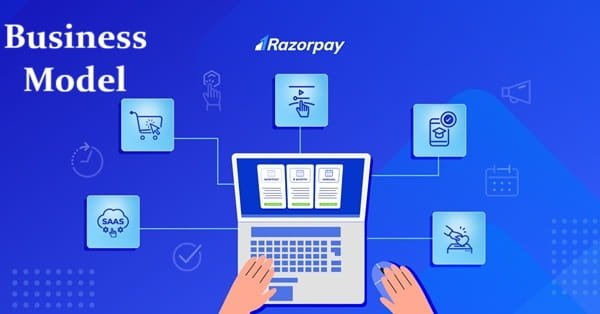
That means Razorpay is no longer just a payment gateway. Its business model now combines transaction fees, business banking and payouts, software subscriptions, international payments, and business credit services. So, let’s understand the Razorpay business model in detail and see exactly how the company makes money from its growing range of payment and financial services.
1. Transaction Fees: The Main Payment Gateway Business
The payment gateway is still the most visible part of Razorpay.
Suppose you buy a shirt online for ₹1,000. The seller uses Razorpay. When you pay, Razorpay connects the seller’s website with the banking and payment network, receives the payment result, and helps the merchant manage the transaction.
For many standard domestic online payment methods, Razorpay’s published standard platform fee is about 2% plus GST on a successful transaction. Certain methods, including international cards and some premium card or EMI payments, can have a higher fee.
So, if the applicable fee on a ₹1,000 order is 2%, Razorpay’s basic platform charge is ₹20 before GST.
The key point is that the merchant using Razorpay normally pays this charge. The shopper does not automatically pay Razorpay simply because its checkout screen appears.
Why are businesses willing to give up a small part of each sale? Because building payment infrastructure from scratch would be expensive and difficult. A company would need to connect with banks and payment networks, secure customer payment data, manage refunds, track settlements, handle failures, and support several payment methods.
Razorpay bundles much of this into one service.
It also offers payment links, payment pages, invoices, QR-based payments, recurring subscriptions, and checkout tools. These products give businesses more ways to collect money while keeping them inside the Razorpay ecosystem.
Razorpay may offer promotional pricing to eligible new businesses from time to time, but the long-term model is based largely on charging businesses when payments are successfully processed.
2. RazorpayX: Revenue From Business Banking and Payouts
Businesses do not only collect money. They also send money out.
A startup may need to pay suppliers, refund customers, reimburse employees, transfer salaries, pay taxes, and make hundreds of vendor payments every month. RazorpayX is designed around these jobs.
RazorpayX is often called a business banking platform, but Razorpay itself is not a bank. RazorpayX-powered current accounts are offered through partner banks, while Razorpay provides the technology and business-finance tools around them.
A company can use RazorpayX to:
- Make bulk vendor payments.
- Automate customer refunds.
- Send employee salaries.
- Set approval rules for company payments.
- Connect banking activity with accounting software.
- Manage taxes and other business payouts.
Razorpay can earn through payout charges, paid plans, subscriptions, and value-added business services.
Consider an online marketplace with 1,000 sellers. Taking money from shoppers is only half the process. The marketplace must also send money to those sellers. Doing that manually would require significant staff time. Automated payouts make the process faster and easier, so businesses are willing to pay for the service.
This also gives Razorpay recurring usage. Customer purchases may rise and fall, but salaries, refunds, vendor payments, and business transfers happen month after month.
3. Razorpay Capital and Business Credit
Cash flow is a major problem for small businesses.
Imagine a D2C clothing brand preparing for Diwali. It expects strong sales but needs money now to buy inventory, pay manufacturers, and run advertisements. Waiting for future customer payments could mean missing the season.
This is where business credit becomes useful.
Razorpay has built lending and working-capital services for businesses. However, it is important to understand the structure correctly. Razorpay’s digital lending operation works as a lending service provider with regulated financial institutions. In other words, the regulated lender provides the credit; Razorpay supplies technology and helps connect eligible businesses with the lending system.
Razorpay can earn through service fees, technology fees, distribution arrangements, processing-related income, and similar commercial agreements around credit products. The interest paid by the borrower belongs to the lending arrangement and should not simply be treated as Razorpay’s own interest income.
Razorpay has one useful advantage in this area: businesses may already be processing sales through its platform. Their digital payment activity can provide useful information about sales patterns and cash flow.
For a small business, faster access to credit can help fund inventory, advertising, payroll, or short-term operating expenses.
4. Software and Subscription Revenue
Razorpay increasingly earns money like a software company too.
One example is Razorpay Payroll. A growing business has to calculate salaries, generate payslips, handle tax deductions, manage employee records, and take care of statutory payments. Doing this manually every month is time-consuming.
Razorpay sells Payroll through paid subscription plans. The price varies by plan and employee count, creating recurring monthly or annual software revenue.
Other tools in the wider Razorpay ecosystem include:
- Recurring subscription billing.
- GST invoicing and payment collection.
- Vendor and accounts-payable management.
- Accounting integrations.
- Approval workflows.
- Payment-routing technology.
- Enterprise payment infrastructure with custom pricing.
Take a SaaS company charging customers ₹999 every month. It may use Razorpay not only for the first payment, but also for recurring billing, failed-payment retries, invoices, refunds, and reporting.
That relationship is more valuable than a one-time payment. Razorpay becomes part of the company’s daily financial operations.
5. International Payments
Razorpay also earns from Indian companies that sell globally.
A software company in Bengaluru may bill customers in the US. A freelancer may work for a UK company. An Indian D2C brand may receive orders from Dubai or Singapore.
These businesses need a simple way to accept international payments.
Razorpay says its international payment products can serve customers across more than 180 countries and support many currencies. Its published pricing for international card payments is up to around 3% per transaction, while other international collection methods can use different pricing.
International payments can cost more because they involve foreign card networks, currency conversion, dispute handling, fraud checks, and cross-border compliance.
For the merchant, the benefit is convenience: it can sell to customers outside India without building a separate payment setup for every country.
6. Enterprise and Custom Software
A small online shop and a large e-commerce company have very different needs.
A small seller may only need a standard checkout page. A company processing lakhs of transactions may need detailed reporting, several payment processors, advanced routing, stronger fraud controls, custom integrations, and dedicated support.
Razorpay therefore offers enterprise plans and custom pricing.
One example is Razorpay Optimizer, which helps businesses using multiple payment gateways route payments through better-performing options. The idea is simple: if one payment route is having trouble, the system can direct transactions through another route and reduce avoidable failures.
For a large online company, even a small improvement in checkout success can protect a meaningful amount of sales.
At this level, Razorpay is not just charging for moving money. It is selling payment technology and business software.
Why Businesses Are Happy to Pay Razorpay
It saves development time. Razorpay provides APIs, plugins, and no-code tools. Businesses can start collecting online payments without building a complete payment system themselves.
It supports many payment options. One integration can help a seller accept cards, UPI, net banking, wallets, EMI, and other methods.
It can reduce checkout problems. Payment failures and slow checkout pages can lead to abandoned purchases. Razorpay builds tools around routing, retries, and smoother checkout experiences.
It cuts back-office work. Refunds, payouts, invoices, salaries, subscriptions, and reconciliation can otherwise require separate spreadsheets and manual processes.
It grows with the business. A startup might begin with payment links, then add a payment gateway, payouts, payroll, recurring billing, business credit, and international collections.
That expansion is a key part of the Razorpay business model.
A Simple Example of the Razorpay Business Model
Consider a small Indian skincare brand.
At first, it uses Razorpay only to collect payments on its website. Razorpay earns a fee on successful transactions.
As sales grow, the brand uses RazorpayX for vendor payments and customer refunds.
It hires employees and subscribes to Razorpay Payroll.
Before the festive season, it accesses working-capital credit through Razorpay’s lending ecosystem.
Later, it starts selling in the US and UAE and switches on international payments, where transaction charges can be higher.
One business relationship can therefore create several revenue streams for Razorpay over time.
Conclusion
Razorpay started by making online payment collection easier for Indian businesses. Over time, it expanded into many of the financial tasks that happen before and after a payment.
The payment gateway remains the front door. Razorpay earns a small fee when businesses successfully collect money online. But it can also earn from RazorpayX payouts and paid business tools, Payroll subscriptions, enterprise software, international transactions, recurring billing, and services connected with business credit.
So the Razorpay business model is not simply “take 2% from every payment.”
It is closer to building a financial operating system for businesses.
A merchant may come to Razorpay because it needs a payment page. As that merchant grows, it may also need refunds, vendor payments, payroll, subscriptions, credit, international collections, and advanced payment software.
That is how a payment screen a customer sees for only a few seconds can support a much larger business behind the scenes: Razorpay earns small fees across millions of payment and business-finance activities, while building long-term relationships with the companies that use its tools every day.