Thailand’s Board of Investment has reported strong foreign direct investment activity, securing a significant share of incoming corporate capital in the ASEAN region. As multinational firms rapidly diversify their supply chains and establish regional headquarters across Southeast Asia, a secondary, equally important trend has emerged. The digital sector has been a primary catalyst for this corporate migration, with major allocations toward tech infrastructure, data centres, and advanced electronics manufacturing. As these companies establish long-term roots, they require stable, high-end infrastructure for their management teams. Consequently, when corporate leaders decide to buy property in Thailand, they are strategically acquiring premium residential assets to anchor these sprawling new operations, ensuring their top talent has access to world-class living standards.
The Expanding Footprint of the Eastern Economic Corridor
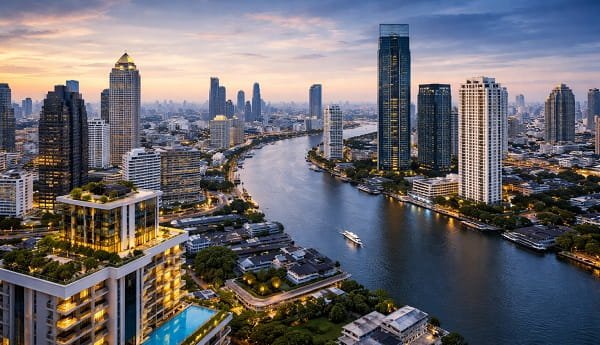
A significant portion of this incoming corporate capital is concentrated in the Eastern Economic Corridor, widely known as the EEC. Spanning the Chonburi, Rayong, and Chachoengsao provinces, this targeted economic zone is undergoing a massive and rapid transformation. The Thai government’s latest economic development strategy is actively positioning the EEC to move beyond traditional manufacturing. Instead, it is becoming a highly specialised hub for smart logistics, biotechnology, artificial intelligence, and corporate management. This shift necessitates a complete reimagining of the local infrastructure to support high-income expatriate families.
Significant infrastructural upgrades, including climate-resilient connectivity improvements around U-Tapao International Airport, are providing the robust multimodal transport networks required for multinational headquarters. This level of physical connectivity ensures that executives can seamlessly commute between global offices and regional technology parks.
Visa Reforms Driving Executive Relocations
To complement this physical infrastructure, policymakers have implemented streamlined regulatory frameworks for incoming executive talent. Recent visa reforms have explicitly prioritised qualified high-net-worth individuals and direct investment pathways, requiring applicants to demonstrate substantial financial resources and investment commitments in Thailand.
With the continued influx of foreign enterprise, the strategic appeal of Thailand’s premium real estate market is increasingly evident for global executives looking to anchor their corporate relocations with high-yield residential properties. These updated visa arrangements significantly reduce administrative friction for frequent business travellers. Furthermore, eligible highly skilled professionals can benefit from streamlined immigration procedures and favourable tax arrangements, making Thailand increasingly attractive for executives relocating with their families.
Building a Strategic Residential Portfolio
As business park amenities and commercial zones expand rapidly, the demand for adjacent executive housing has naturally surged. International buyers account for a substantial share of upper-end luxury property acquisitions in prime real estate destinations. Wealth managers and corporate directors increasingly view these acquisitions as stable offshore assets that serve both practical relocation needs and long-term portfolio diversification.
When selecting these premium landed estates or high-tier condominiums located just outside major economic zones, buyers focus heavily on convenience, security, and lifestyle amenities. Condominiums remain the most frictionless asset class for full foreign freehold ownership, making them incredibly popular among transient executives. However, luxury villa structures situated near expanding business corridors are seeing unprecedented demand for executive housing portfolios, particularly as families seek more space and privacy.
To ensure regulatory compliance and secure investments, corporate buyers are prioritising several key factors in the current market:
- Developer Reputation: Corporate capital is heavily focused on proven market leaders with highly transparent legal structures to ensure regulatory compliance and high rental yields.
- Secure Contractual Mechanisms: The legally secure leasehold structure, often with multiple extension periods, has become a standard contractual mechanism for foreign investors acquiring luxury residential villa properties.
- Succession Planning: Modern leasehold contracts now commonly feature robust succession clauses to protect substantial investments for future generations.
- Proximity to Commercial Corridors: Prime valuation growth is heavily tied to areas with direct highway access to the EEC, new enterprise zones, and major international airports.
The seamless synergy between expanding commercial business corridors and executive residential housing creates a highly dynamic environment for global corporate migration. The fusion of commercial growth and residential luxury is redefining how multinational firms approach regional expansion. As special economic zones continue to mature and attract top-tier talent, the integration of smart logistics hubs, highly favourable visa policies, and premium real estate opportunities will only strengthen Southeast Asia’s position as a premier destination for global enterprise and wealth management for decades to come.