The language of insurance doesn’t seem important in regular driving experiences before an accident makes its implications clear. Third-party liability and indemnification are examples of terminology used to describe what the policy covers in practice when there is an accident involving another car or individual.
The choice to renew third party insurance in time ensures that one does not face problems due to lack of insurance coverage. That is why this blog sheds light on the importance of third-party insurance through practical examples from the Indian context.
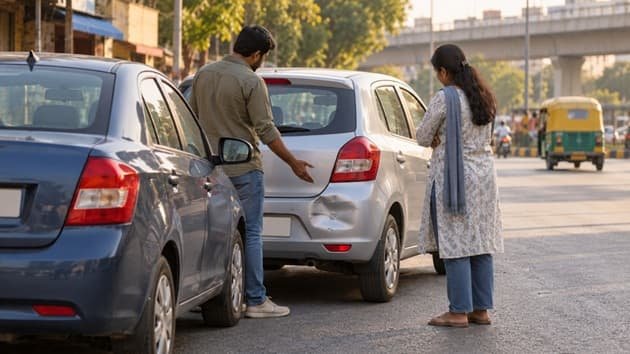
How a Minor Junction Collision Can Lead to Significant Consequences
Consider one of the most common urban incidents: a slow-speed collision at a traffic signal. A vehicle rolls forward slightly and makes contact with the car ahead. The damage looks superficial: a dented bumper and a cracked taillight. Both drivers step out, assess the situation, and the at-fault driver assumes the matter will resolve itself with a brief conversation.
- What the at-fault driver may not have considered is that the other party has the legal right to claim for their vehicle damage and, if anyone in that vehicle sustained even a minor injury, for that as well.
- Car Insurance with third-party liability cover means your insurer steps in to address that claim on your behalf. Without it, because the policy lapsed or was never in place, that liability is yours to handle personally.
- The Motor Vehicles Act, 1988 exists precisely because incidents like this happen constantly on Indian roads, and the financial consequences for those on the receiving end should not depend entirely on the at-fault driver’s ability or willingness to pay.
A Pedestrian Incident and What the Law Provides
Pedestrian involvement in road incidents is a significant concern across Indian cities. Footpaths are inconsistent, road crossings are unpredictable, and pedestrians and vehicles share space in ways that would not be acceptable in many other countries.
- If a vehicle causes injury to a pedestrian, even at low speed, even in circumstances where fault is disputed, the legal framework in India allows the injured person to pursue compensation through a Motor Accident Claims Tribunal.
- There is no statutory cap on compensation for personal injury or death claims. The figures awarded in such cases can be considerable.
- Third-party cover responds to exactly this kind of situation. It covers the policyholder’s legal liability arising from injury or death caused to another person. It also covers damage to third-party property, subject to the limits specified in the policy.
The Parked Vehicle Scenario
It is important to remember that not all incidents involve moving vehicles. A common occurrence on congested Indian roads is damage caused to a parked vehicle, or contact made with a stationary car while navigating a narrow lane.
- Third party insurance covers your liability for the damage caused to another person’s vehicle in exact situations like this. The owner of the parked vehicle is the third party in this scenario.
- What it does not cover is any damage to your own vehicle. That is a distinction that matters. Third-party cover is directed outward, towards others.
- Your own vehicle’s repair in this scenario falls outside its scope entirely. For drivers who want that protection as well, a comprehensive policy is the structure that provides it.
Why Renewal Cannot Be Treated as Optional
This brings the discussion back to the most important practical consideration: the decision to renew third party insurance is not a discretionary one. The law requires it, and the traffic enforcement applies it. And the real-world incidents described above, none of which are unusual or unlikely, are exactly the circumstances where the presence or absence of valid cover becomes the only thing that matters.
Conclusion
Most insurers provide a window of around 30 to 90 days after a policy expires within which renewal remains possible, though the specific terms vary between providers. Crucially, any incident occurring during that post-expiry window cannot be claimed against, even if renewal is eventually completed. Cover resumes from the date of renewal, not from the date of expiry. The incidents on India’s roads do not pause for any delays. So, your cover should also include all those factors.