India’s rapid transition toward clean power has transformed the energy market, with non-fossil fuel sources now accounting for over 51% of the total installed capacity as of late 2025. While the availability of components makes do-it-yourself (DIY) projects seem accessible, the technical complexity of modern systems necessitates specialized expertise. Choosing a certified provider among the EPC companies in India ensures that a solar energy system is not only compliant with the latest grid standards but also optimized for long-term financial returns. Professional Engineering, Procurement, and Construction (EPC) services mitigate the risks associated with improper installation, regulatory hurdles, and component mismatch.
Technical Expertise: Why TOPCon Technology Requires Professional Handling
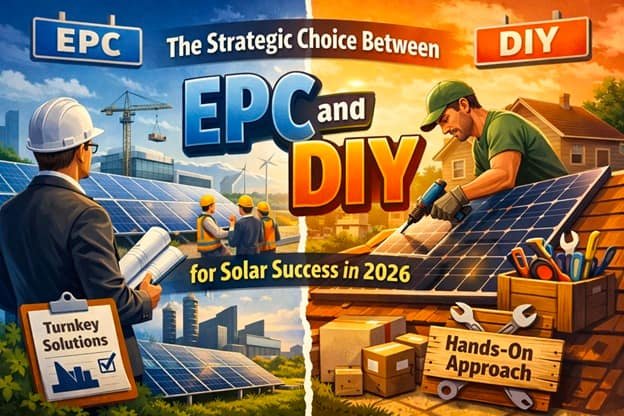
The shift toward N-Type TOPCon technology in 2026 has set a new benchmark for efficiency, reaching cell performance levels of 25% to 26%. These advanced modules require precise handling and specific electrical configurations to deliver their promised yield. DIY installations often lack the specialized equipment needed for accurate site shading analysis and structural load-bearing assessments.
EPC companies in India utilize advanced tools to ensure that high-wattage modules (610Wp to 720Wp) are mounted at optimal tilt angles. Improper mounting in a DIY setup can lead to micro-cracks or “hot spots,” significantly reducing the system’s lifespan. Professional installers ensure that the balance-of-system (BoS) components, such as inverters and DC cables, are perfectly matched to these high-efficiency modules to prevent energy loss.
Professional technical management is essential to maximizing energy output from modern, high-performance solar hardware.
Compliance and Safety: Meeting 2026 Grid Standards
The Ministry of Power has reported that national energy shortages were reduced to 0.03% in FY 2025-26. This stability is maintained through strict grid codes that every solar energy system must follow. A DIY project may bypass critical safety measures, such as proper earthing, lightning protection, and the installation of high-quality circuit breakers, which can lead to fire hazards or grid disconnection.
Certified EPC providers handle the rigorous testing mandated by Indian standards (BIS and IEC). They ensure that the system supports grid-functional parameters like “Low Voltage Ride Through.” Furthermore, only systems installed by certified vendors are eligible for net metering, a requirement for reducing electricity bills in urban areas, where power availability now averages 23.4 hours.
Safety and regulatory adherence provide the necessary foundation for a solar project to operate legally and securely within the national grid.
Financial Logic: Subsidies and Lifecycle Costs
While DIY might seem to save on labor costs initially, it often results in the loss of government financial assistance. Under the PM Surya Ghar: Muft Bijli Yojana, subsidies of up to ₹78,000 for a 3kW system are only available if the installation is completed by an MNRE-registered vendor.
| Feature | Certified EPC Company | DIY Installation |
| Central Subsidy (CFA) | Fully Eligible | Ineligible |
| Performance Warranty | 25-30 Years | Often Voided by Manufacturer |
| Net Metering Approval | Facilitated by Provider | Complex Individual Process |
| Payback Period | 3 to 6 Years | 8+ Years (Due to no subsidy) |
The long-term asset life of a solar plant, often exceeding 25 years, makes maintenance a critical factor. Leading EPC companies in India offer comprehensive Operation and Maintenance (O&M) packages, whereas DIY owners must bear the cost and risk of repairs themselves.
Securing government incentives through professional installation significantly improves the internal rate of return for any solar investment.
Must Read:- Solar Panel Manufacturing Process in India
Supply Chain Reliability and Component Quality
Sourcing reliable components in a crowded market is a challenge for individual buyers. EPC providers have established relationships with solar manufacturers who are ALMM-enlisted. This enlistment ensures that the modules are verified for quality and performance. A DIY buyer might inadvertently purchase non-compliant or sub-standard modules that fail prematurely.
By partnering with a major energy group, such as Avaada, that manages its own module production, developers gain access to the latest N-Type TOPCon bifacial modules. This vertical alignment ensures that the solar energy system uses components tested for the specific climatic conditions of high-growth states such as Rajasthan, Gujarat, and Maharashtra.
Access to a verified supply chain prevents the deployment of inefficient or obsolete technology in a renewable energy project.
Final Thoughts
In 2026, the complexity of India’s power grid and the sophistication of TOPCon technology make professional EPC services indispensable. While DIY may appear to offer short-term savings, the risks of subsidy loss, technical failure, and regulatory non-compliance are too great. Partnering with established EPC companies in India ensures a seamless transition to clean energy, backed by technical excellence and financial security. This approach aligns with the national goal of electricity reaching 40% of the total energy basket by 2047, ensuring that every solar energy system contributes effectively to a greener Bharat.